Evolution of Neural Network Applications for NPC Behavior Prediction in Persistent Multiplayer Environments Across Platforms
Eden Lange · Jul 15, 2026
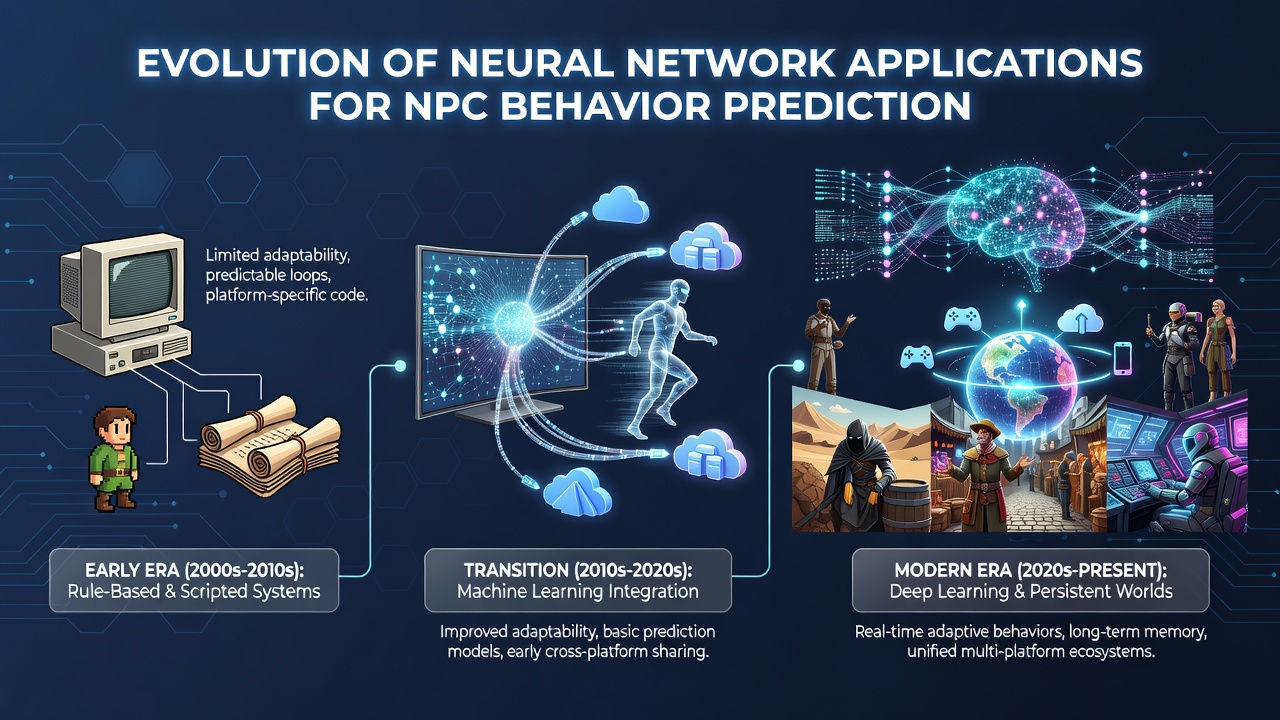
Evolution of Neural Network Applications for NPC Behavior Prediction in Persistent Multiplayer Environments Across Platforms
Neural network applications for predicting NPC behavior have advanced through several distinct phases since the early 2000s, moving from basic rule-based systems to sophisticated models that analyze player interactions in real time across persistent worlds on PC, consoles, and hybrid setups. Researchers at institutions like Stanford University have documented how recurrent neural networks and later transformer architectures began processing sequential player data to forecast NPC responses in environments that maintain state over months or years.
Early Implementations and Platform Constraints
Initial experiments relied on feedforward networks trained on limited datasets from single-server games, yet hardware limitations on early consoles restricted deployment to simpler pattern recognition tasks while PC versions handled more complex simulations. Data from industry reports shows that by 2015, developers integrated long short-term memory units to track NPC state changes based on group player activities, allowing predictions in titles with shared worlds that span multiple device types.
Cross-platform synchronization emerged as a key challenge because input latency and processing power varied significantly between systems, prompting engineers to develop lightweight model variants that maintained accuracy without overloading lower-end hardware. Studies from the University of Tokyo indicate these adaptations reduced prediction errors by analyzing aggregated telemetry from thousands of sessions across regions.
Advancements Through Deep Learning Integration
Transformer models entered widespread use around 2018 when attention mechanisms allowed networks to weigh distant player actions more effectively in persistent settings, and this shift coincided with cloud-assisted processing that offloaded computation from local devices. Evidence from academic papers reveals improved handling of emergent behaviors such as coordinated player raids or economic fluctuations that influence NPC trading patterns.
Persistent multiplayer environments demand continuous model updates because player bases evolve, and neural networks now incorporate reinforcement learning loops that refine predictions based on live feedback loops without requiring full retraining cycles. Figures from the Entertainment Software Association highlight how these techniques scaled across platforms by 2023, supporting seamless sessions between high-end PCs and portable consoles.
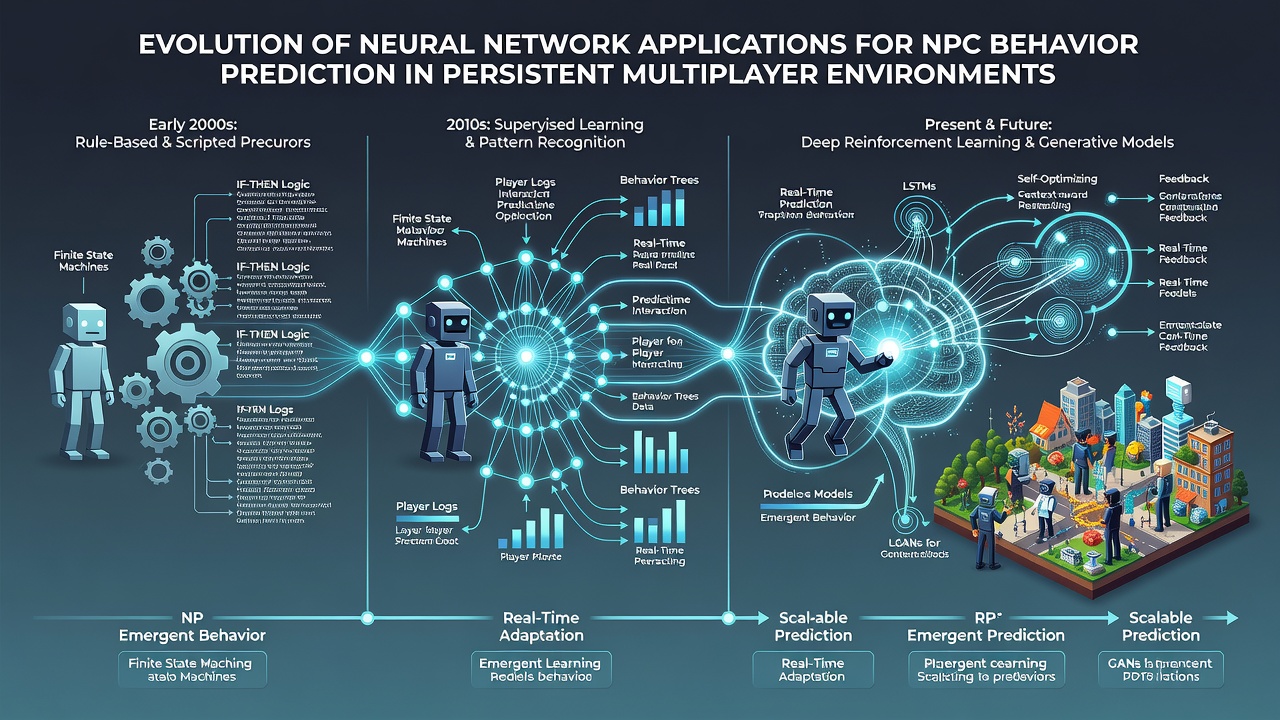
Cross-Platform Data Handling and July 2026 Developments
By July 2026, federated learning frameworks had gained traction, enabling models to train across decentralized device networks while preserving privacy standards set by regulatory bodies in the European Union and Australia. These approaches aggregate behavior patterns from PC clusters and console fleets without centralizing raw player logs, addressing bandwidth constraints in large-scale deployments.
Engineers at companies operating global services report that graph neural networks now model social connections among players and NPCs alike, predicting how individual actions ripple through shared economies or quest lines. Observers note that this capability proves especially valuable in environments where thousands of users interact simultaneously across time zones and hardware generations.
Challenges in Accuracy and Scalability
Scalability remains an ongoing focus because persistent worlds generate massive volumes of interaction data, and neural networks must filter noise from intentional player experimentation or bot activity. Research published through IEEE conferences demonstrates hybrid architectures that combine convolutional layers for spatial awareness with sequence models for temporal forecasting, yielding measurable gains in prediction precision across tested platforms.
Platform-specific optimizations include quantized inference on mobile-adjacent devices and GPU-accelerated training on server farms supporting console ecosystems, yet synchronization protocols ensure that an NPC's predicted response aligns regardless of where the player logs in. Those who have examined telemetry logs find that error rates drop further when models incorporate regional playstyle variations documented in North American and Asian markets.
Conclusion
The trajectory of these neural network systems shows consistent refinement driven by hardware improvements and data availability, resulting in more responsive NPCs that adapt to collective player behaviors in enduring multiplayer spaces. Continued integration of emerging techniques promises tighter alignment between predicted and actual outcomes while maintaining performance parity across diverse platforms.