How Environmental Audio Cues Guide Exploration Behaviors in Expansive Digital Worlds Without Explicit Markers
Katja Krause · Jun 10, 2026

How Environmental Audio Cues Guide Exploration Behaviors in Expansive Digital Worlds Without Explicit Markers
Expansive digital worlds often rely on layered sound design to direct player movement when visual markers remain absent, and data from multiple industry analyses show that ambient audio layers influence path selection rates by measurable margins. Researchers tracking navigation patterns across large-scale titles observe that changes in wind intensity or distant echoes prompt directional shifts more consistently than static environmental visuals alone.
Core Mechanisms Behind Audio-Driven Navigation
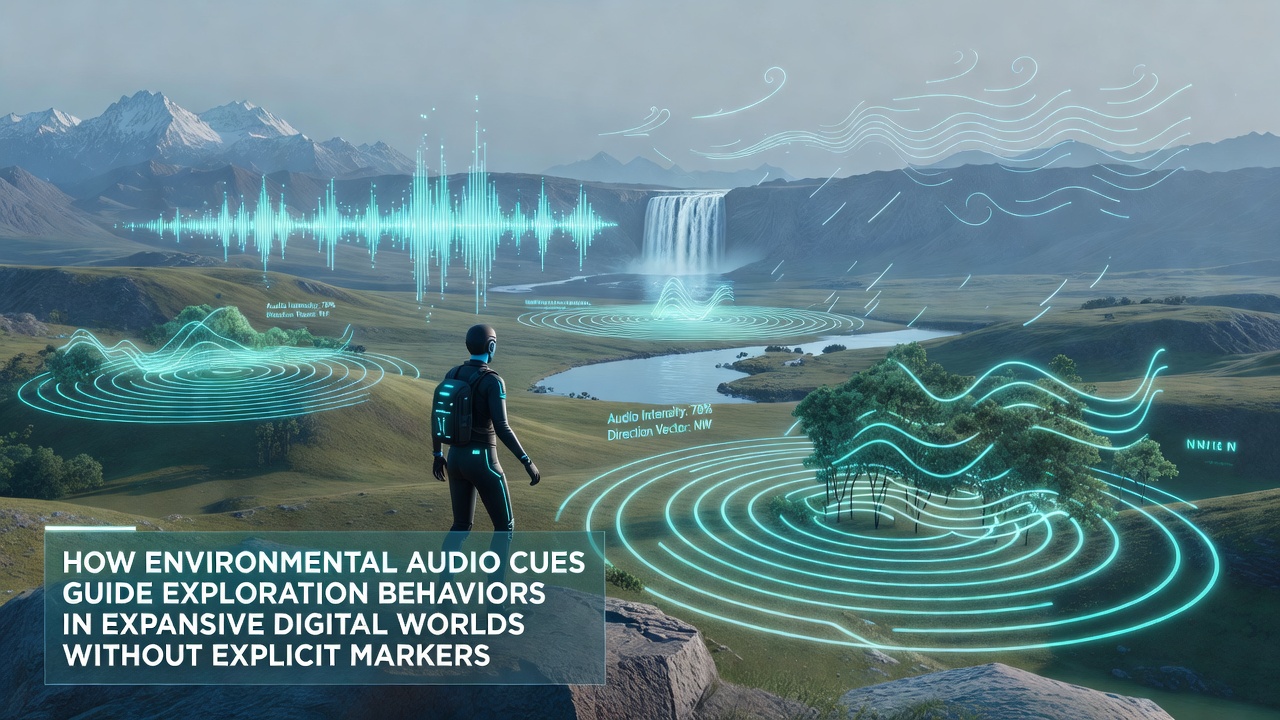
Environmental audio operates through dynamic attenuation and spatial positioning where sound sources adjust in real time based on player proximity and orientation, while procedural generation systems modulate volume and frequency to create directional pull. Studies compiled by the Entertainment Software Association indicate that titles employing these techniques see exploration completion metrics rise when audio cues align with terrain transitions rather than remaining uniform across zones. Players respond to pitch variations in river flows or foliage rustling by altering trajectories, and this response occurs without conscious recognition in many cases according to eye-tracking data collected during controlled play sessions.
Examples from Established Titles
One researcher documented how creature vocalizations in procedurally generated biomes lead participants toward resource clusters at higher frequencies than random chance would predict, and similar patterns emerge when analyzing player heat maps from survival-focused releases. In environments where visual landmarks stay minimal, low-frequency rumbles from underground systems draw attention downward, prompting vertical exploration that would otherwise require external prompts. Data collected across console and PC platforms reveal consistent correlations between these audio shifts and increased dwell time in unmarked areas.
Technical Implementation in Modern Engines
Game engines integrate middleware for real-time audio propagation that accounts for occlusion, reflection, and distance falloff, allowing environmental sounds to evolve as players cross boundaries between regions. Engineers adjust reverb parameters tied to material surfaces so that echoes from stone caverns differ distinctly from those in forested clearings, creating subconscious wayfinding tools. As of June 2026 several major engines have incorporated enhanced binaural rendering options that further refine how these cues translate across varied hardware setups including handheld devices.
Developers calibrate these systems using player telemetry that logs position alongside audio event triggers, and the resulting datasets allow refinement of cue placement without introducing explicit guidance elements. Industry reports from the Interactive Games and Entertainment Association in Australia highlight that teams using telemetry-driven iteration reduce instances of players becoming disoriented in expansive maps by significant percentages compared to earlier builds lacking such calibration.
Player Behavior Patterns and Retention Data
Analytics platforms record that sessions featuring responsive environmental audio maintain longer continuous play intervals when exploration relies on auditory feedback loops instead of visual indicators. Those who study retention metrics note that players encountering evolving soundscapes return to previously visited zones at elevated rates because the audio continues to offer fresh directional information on subsequent visits. Cross-platform data further shows that these patterns hold steady whether participants use controllers, keyboards, or touch inputs, suggesting the guidance effect stems primarily from the audio design rather than input method.
Research Findings on Effectiveness
Academic investigations conducted through European research consortia demonstrate that participants exposed to spatially accurate environmental sounds complete unmarked navigation tasks faster on average than control groups relying solely on visual scanning. The studies emphasize that overlapping audio layers, such as combining distant wildlife calls with shifting atmospheric tones, produce stronger behavioral responses than isolated cues. Observers note that when these layers sync with weather or time-of-day cycles the guidance becomes even more pronounced, encouraging players to adjust pacing naturally within the world.
Future Directions in Audio Guidance Systems
Emerging techniques involve machine learning models that adapt cue intensity based on aggregate player movement data collected across live sessions, and preliminary implementations already appear in select live-service titles. These models prioritize subtlety so that audio remains atmospheric while still providing functional navigation support, and ongoing work focuses on reducing computational overhead for broader deployment across mid-range hardware. Figures from recent developer conferences reveal growing investment in these adaptive systems as teams seek to balance discovery freedom with implicit direction.
Conclusion
Environmental audio cues continue to shape how players traverse large digital spaces by embedding directional information within atmospheric layers that feel organic to the world itself. Research across academic and industry sources confirms measurable impacts on navigation efficiency and session duration when these systems receive careful calibration. As engine capabilities expand and telemetry tools improve, the integration of such cues is expected to grow more refined while staying invisible to the player experience.