How Neural Network Optimizations Refine Non-Player Character Interactions to Create More Responsive Worlds in Current Generation Entertainment Software
Eden Lange · Jul 31, 2026

How Neural Network Optimizations Refine Non-Player Character Interactions to Create More Responsive Worlds in Current Generation Entertainment Software
Neural network optimizations have transformed how non-player characters respond to players in entertainment software by enabling dynamic behavior adjustments that draw from real-time inputs rather than fixed scripts. Developers integrate these systems into current generation titles across consoles and PCs, where models trained on vast datasets allow NPCs to predict player intent and adjust dialogue trees, pathfinding, and combat tactics accordingly. Data from industry reports indicate that such refinements reduce latency in interactions while increasing the density of meaningful exchanges within open environments.
Core Mechanisms Behind NPC Refinements
Engineers apply reinforcement learning variants and pruned convolutional networks to compress decision-making processes, which permits NPCs to evaluate multiple environmental variables simultaneously without exceeding hardware limits on PlayStation 5 or Xbox Series X. These optimizations often involve quantization techniques that shrink model sizes by up to 70 percent, according to findings shared at developer conferences in early 2026, yet preserve accuracy in behavior classification. Observers note that hybrid approaches combining neural outputs with traditional behavior trees maintain stability during complex scenes involving dozens of characters.
Training pipelines now incorporate player telemetry collected from live-service updates, allowing models to evolve post-launch and adapt to shifting community strategies. Researchers at institutions across North America and Europe have documented cases where NPCs learned to prioritize cover usage or form temporary alliances based solely on repeated exposure to skilled opponents. This process unfolds through episodic memory modules that store key events, which the network references during subsequent encounters to vary responses and avoid repetitive patterns.
Applications in Contemporary Titles
Action-adventure releases scheduled through July 2026 demonstrate these capabilities in practice, with NPCs that alter patrol routes based on player stealth habits or initiate context-aware conversations after observing environmental changes. One prominent example involves urban simulation games where vendor characters adjust inventory prices according to accumulated player reputation metrics processed through optimized recurrent layers. Such systems create worlds that register cumulative actions across sessions rather than resetting at each load.
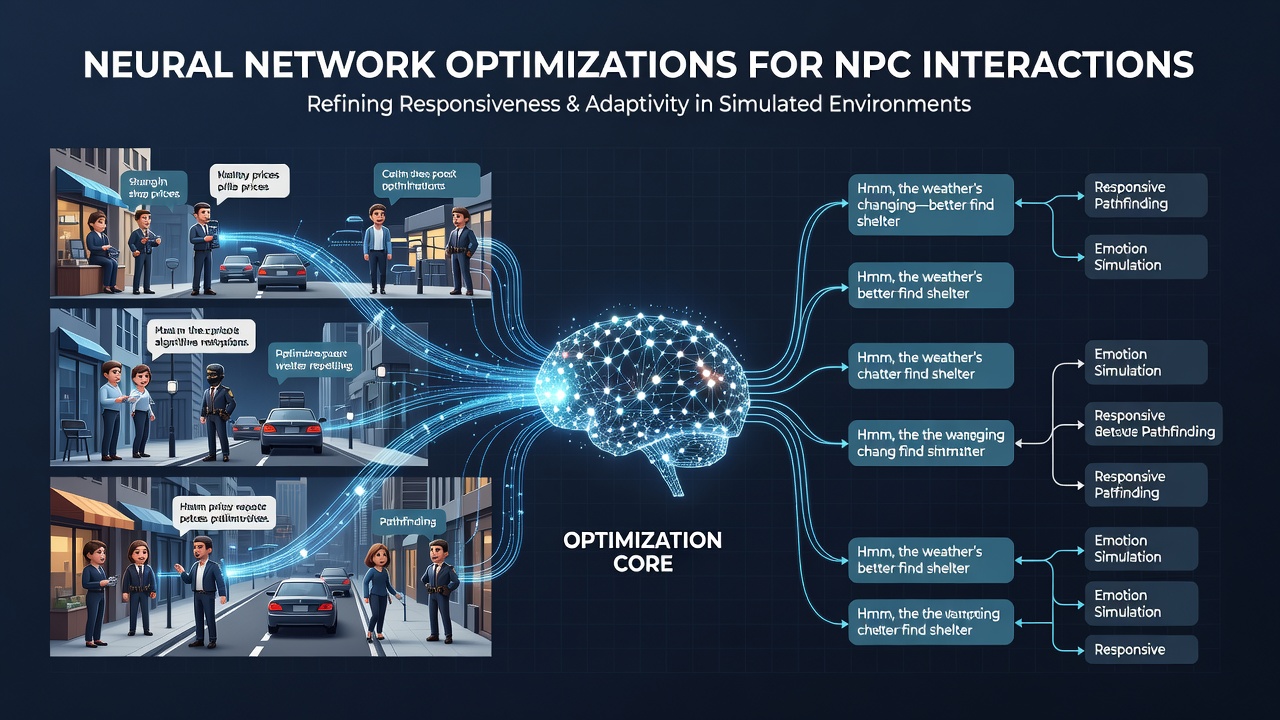
Multiplayer titles benefit similarly when server-side neural inference handles crowd simulations, ensuring bystander reactions scale with the number of participants without frame drops. Figures released by the Entertainment Software Association reveal that titles employing these optimizations report higher session retention rates compared with predecessors that relied on static scripting alone. Industry data further highlights regional variations, with European studios leading in lightweight edge-computing deployments that push partial inference to client hardware.
Performance and Scalability Considerations
Hardware constraints in Nintendo Switch ports require aggressive model distillation, where larger teacher networks guide smaller student variants that run efficiently on mobile-derived processors. This yields responsive crowd behaviors in portable sessions while preserving core interaction fidelity seen on higher-powered platforms. Academic papers from University of Tokyo researchers detail how attention mechanisms within these distilled models focus computational resources on the most relevant NPCs at any moment, which prevents resource contention during dense exploration sequences.
Developers also address edge cases through adversarial training that exposes networks to rare player actions, reducing instances where characters freeze or loop animations inappropriately. Technical evaluations from international teams show measurable gains in perceived intelligence scores when such safeguards accompany optimization passes.
Conclusion
Neural network optimizations continue to expand the range of believable NPC interactions available in entertainment software by balancing computational efficiency with adaptive depth. As hardware evolves and training datasets grow more diverse, these techniques support increasingly intricate world responses that register player history and environmental context in real time. The trajectory points toward broader adoption across genres, driven by measurable improvements in engagement metrics and technical feasibility documented through ongoing industry and academic efforts.