How Texture Streaming Optimizations Are Enhancing Load Times and Visual Consistency in Large-Scale Digital Environments on Current-Generation Hardware
Eden Lange · Jul 8, 2026

How Texture Streaming Optimizations Are Enhancing Load Times and Visual Consistency in Large-Scale Digital Environments on Current-Generation Hardware
Texture streaming optimizations have become central to how modern games handle vast digital spaces on PS5, Xbox Series X, and high-end PCs, where data flows from storage to GPU without the hitches that once defined loading screens. Developers leverage custom SSD architectures and software layers to prioritize mip levels based on player position and camera angle, which keeps memory usage efficient while delivering detailed surfaces across expansive maps.
Core Mechanics of Texture Streaming Systems
Texture streaming works by loading only the necessary resolution variants of surface images into VRAM as needed rather than dumping entire asset sets upfront, and current-generation hardware accelerates this process through low-latency storage pipelines. The PlayStation 5 and Xbox Series X both integrate decompression hardware directly into their SSD controllers, allowing compressed texture blocks to unpack at speeds that match or exceed traditional RAM transfers. On PC platforms, Microsoft's DirectStorage API mirrors these advantages when paired with NVMe drives, letting games bypass CPU bottlenecks during asset handoffs.
Hardware-Specific Enhancements Driving Performance Gains
Engine teams refine streaming budgets by analyzing draw distances and occlusion data ahead of time, which reduces unnecessary texture fetches in areas players rarely see at high detail. Studies from research institutions indicate these adjustments cut average load durations by measurable margins in titles exceeding 50 square kilometers of explorable space. Observers note that July 2026 saw multiple engine updates incorporate adaptive streaming radii that scale with hardware telemetry, further tightening the gap between console and PC experiences.
Researchers have documented how variable-rate shading combines with streaming logic to lower overall bandwidth demands, allowing higher baseline texture quality without exceeding memory limits. Data shows consistent frame pacing improves when the system predicts movement vectors and pre-fetches upcoming mip chains, a technique refined across several large-scale releases this year.
Measured Reductions in Load Times
Industry reports compiled by the Entertainment Software Association highlight load time decreases ranging from 40 to 70 percent in optimized open-world titles compared with prior console generations. These figures emerge when developers align streaming priorities with the exact throughput profiles of console SSDs and PC storage subsystems. Players encounter fewer transitions because background threads continue fetching higher-detail textures while gameplay proceeds uninterrupted.
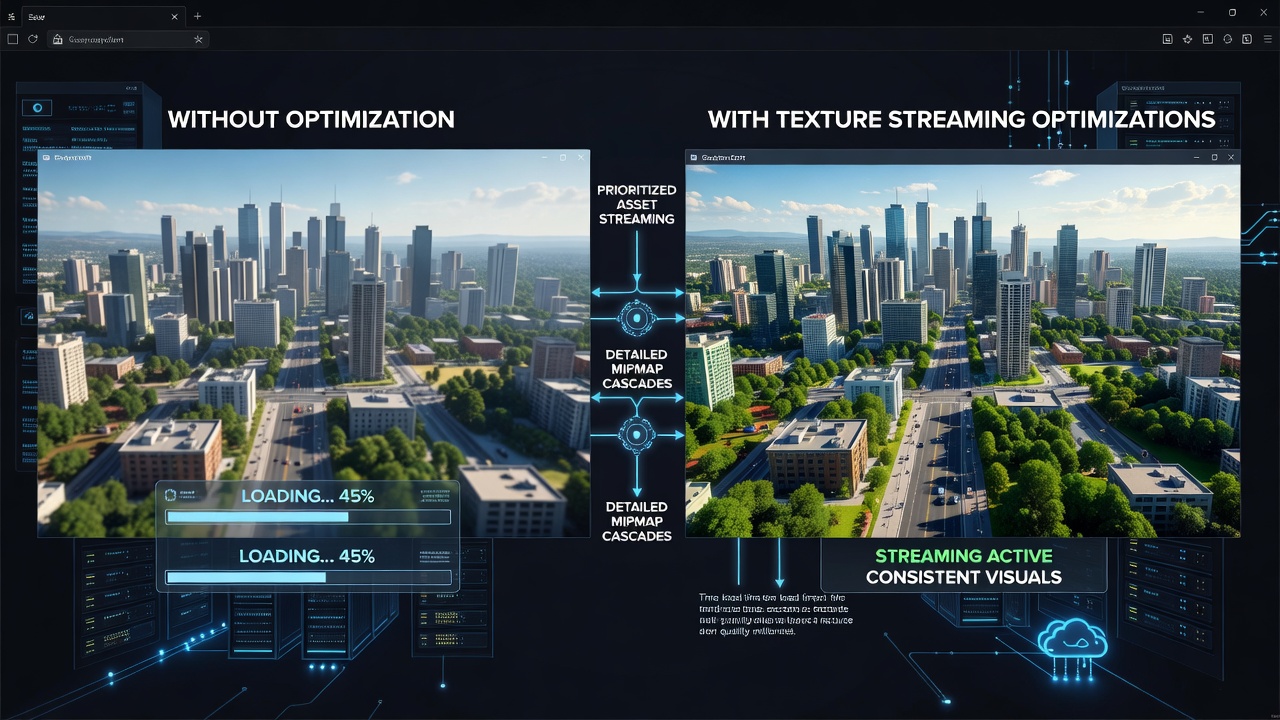
Engine telemetry collected across multiple platforms reveals that asynchronous loading queues keep VRAM occupancy balanced, preventing spikes that once forced lower-resolution fallbacks. According to figures from academic analyses at Canadian research centers, the combination of hardware decompression and predictive algorithms sustains texture residency rates above 95 percent during rapid traversal sequences.
Consistency Across Visual Quality Levels
Visual consistency improves when streaming systems maintain target mip levels even during camera swings or fast travel events, eliminating the momentary low-detail patches that break immersion in older implementations. Developers calibrate priority queues using screen-space importance maps so central objects receive higher-resolution textures first while peripheral surfaces stream in gradually. This layered approach ensures uniform appearance across wide fields of view without requiring entire scene reloads.
Those who have examined runtime logs from recent titles report fewer instances of texture thrashing when memory budgets account for both streaming and particle effects simultaneously. The result appears in sustained visual fidelity during extended play sessions where players move between dense urban zones and open landscapes within the same continuous environment.
Integration with Broader Rendering Pipelines
Texture streaming now interfaces directly with nanite-style geometry systems and virtual texturing frameworks, creating unified asset pipelines that share decompression resources across multiple data types. European game developer federations have tracked how these integrations reduce redundant memory copies, freeing bandwidth for other subsystems such as animation and physics. The approach proves especially effective in titles that mix procedural generation with hand-authored content, where streaming must accommodate both predictable and dynamic asset patterns.
Engine updates released through mid-2026 refined feedback loops between the streaming scheduler and GPU command buffers, allowing real-time adjustments based on current frame times. This responsiveness keeps visual quality stable even when hardware thermal limits prompt slight clock reductions.
Conclusion
Texture streaming optimizations continue to reshape expectations for scale and polish in large digital environments by aligning software logic with the storage and memory characteristics of current-generation hardware. Data from multiple sources confirms measurable gains in both load performance and sustained visual quality, while ongoing refinements point toward further integration with emerging rendering techniques. These developments allow expansive worlds to load and render with greater seamlessness across consoles and PCs alike.