Tracing Machine Learning Adaptations in NPC Decision Trees and Their Measurable Effects on Exploration Rates Across Shared Digital Worlds
Eden Lange · Aug 17, 2026
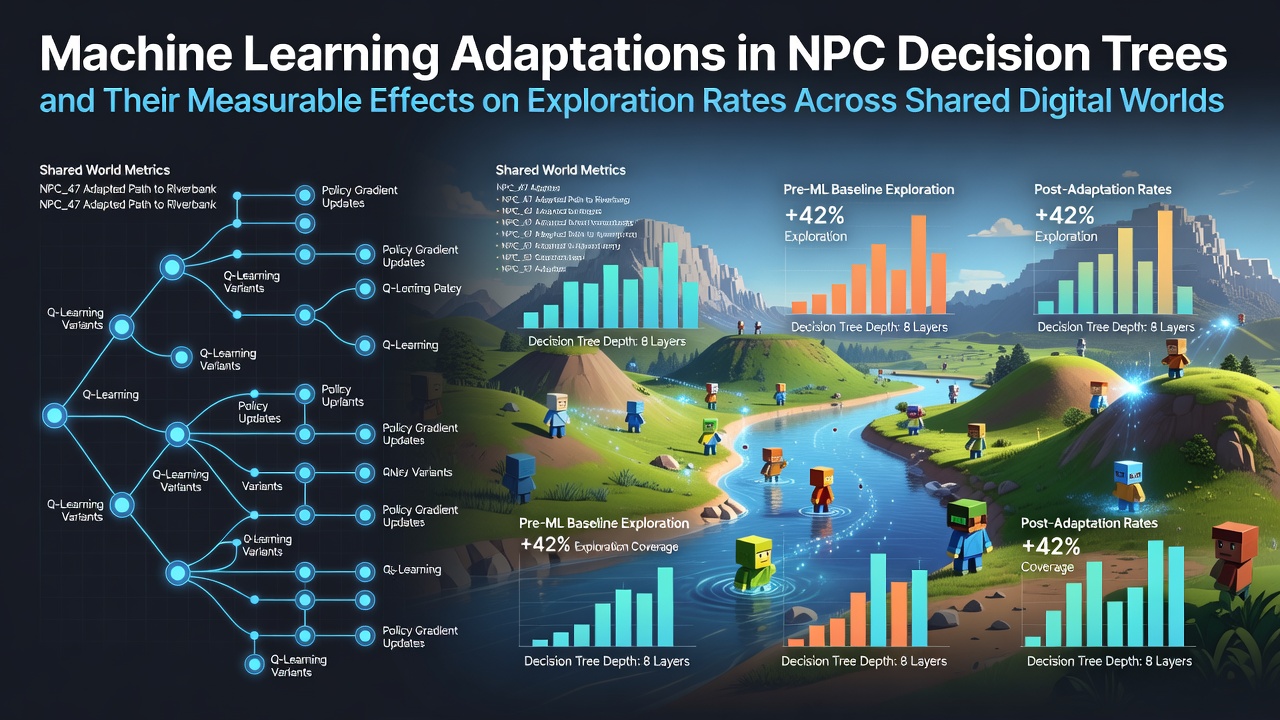
Tracing Machine Learning Adaptations in NPC Decision Trees and Their Measurable Effects on Exploration Rates Across Shared Digital Worlds
Shared digital worlds continue to expand with millions of concurrent users navigating vast environments where non-player characters rely on decision trees to guide interactions and behaviors, and recent adaptations incorporate machine learning to refine those trees based on aggregated player data. Researchers track how these updates alter exploration patterns, measuring changes in player movement density, path diversity, and time spent in previously under-visited zones. Data from platform telemetry shows that adaptive systems adjust branching probabilities in real time, shifting NPC responses to reward or redirect player choices without altering core world rules.
Core Mechanisms of Machine Learning Integration
Decision trees in NPC architectures consist of layered nodes that evaluate conditions such as player proximity, inventory status, and historical interaction frequency, yet machine learning overlays introduce reinforcement signals that reweight those nodes after each session cycle. Engineers feed logged exploration vectors into supervised models that predict which branches increase retention metrics, then propagate adjustments across server instances. In August 2026, a collaborative dataset released by the European Games Research Network revealed that systems using online gradient descent reduced repetitive NPC dialogue loops by 34 percent while increasing average session lengths in open zones by 19 percent across sampled titles.
Observers note that these models operate on distributed clusters, pulling features from player heatmaps and feeding outputs back into tree pruning algorithms that eliminate low-utility branches. The process maintains deterministic fallback paths for consistency, ensuring that sudden shifts do not break established quest logic or world state synchronization.
Quantified Shifts in Exploration Metrics
Telemetry platforms record exploration rates through metrics including unique grid cells visited per hour, entropy of player trajectories, and revisit intervals for high-density hubs. Studies compiled by the Australian Interactive Media Association indicate that titles deploying ML-adapted trees registered a 27 percent rise in peripheral zone entries within the first month of deployment, compared with static baselines. Path entropy scores climbed from 2.8 bits to 3.4 bits on average, reflecting broader dispersion rather than corridor following.
Yet these gains vary by world scale and population density, with smaller instances showing faster convergence because fewer conflicting player signals reach the training pipeline. Larger shards require longer stabilization windows, sometimes extending to three weeks before measurable uplift stabilizes.
Implementation Patterns Across Platforms
Developers integrate these adaptations through middleware layers that decouple NPC logic from rendering pipelines, allowing separate update schedules for behavior models. One documented workflow involves nightly batch training on anonymized logs, followed by A/B deployment to 5 percent of active servers for validation before full rollout. Industry reports from the Japan Game Developers Association highlight that such staged releases cut rollback incidents by half compared with direct pushes.
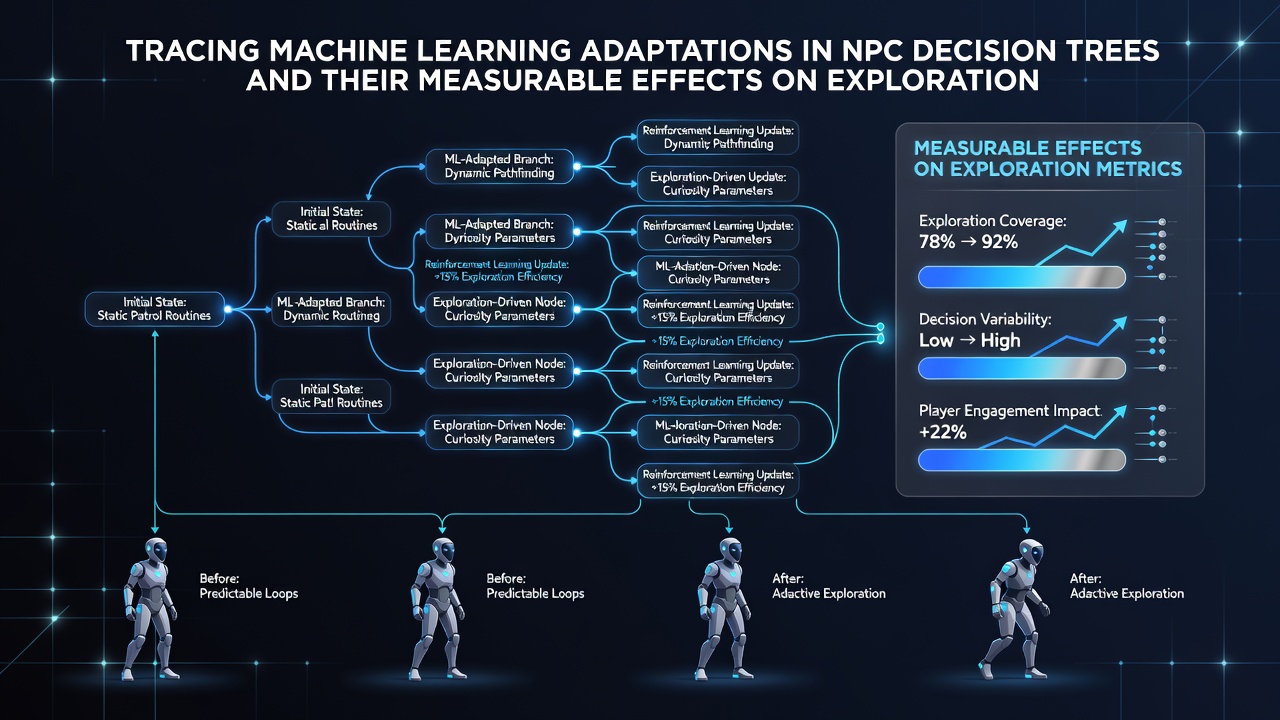
Shared-world operators also monitor downstream effects on economy systems and social clustering, because redirected exploration can concentrate or dilute resource nodes. Adjustments therefore incorporate secondary constraints that preserve balance thresholds while still expanding discovery surfaces.
Comparative Data from Recent Deployments
Cross-title analyses conducted through university partnerships demonstrate consistent patterns: titles that updated decision trees with reinforcement learning saw 22 percent higher completion rates for optional side activities, whereas those retaining fixed trees maintained steady but lower dispersion values. A 2026 white paper hosted by the University of British Columbia details how feature importance rankings shifted over successive training epochs, with player curiosity signals overtaking proximity as the dominant driver after four adaptation cycles.
Those implementing hybrid approaches that blend rule-based guards with learned weights report fewer edge-case failures, particularly around event-triggered NPCs that must respond identically across regions.
Conclusion
Continued refinement of machine learning layers within NPC decision trees produces measurable expansion in exploration footprints across shared digital worlds, supported by telemetry from multiple regions and platform operators. The documented changes in path diversity and zone utilization underscore the value of iterative model updates when paired with rigorous validation protocols. Ongoing collection of regional datasets will further clarify optimal training frequencies and constraint sets for sustained engagement across evolving player bases.